Skip to content

What is Bronze Powder? Why Does It Exhibit Metallic Luster?
Bronze powder is a metallic effect pigment primarily composed of a copper-zinc alloy, appearing in color tones such as golden yellow, light gold, and bronze. Due to its visual similarity to real gold, it is also known as “imitation gold powder.”
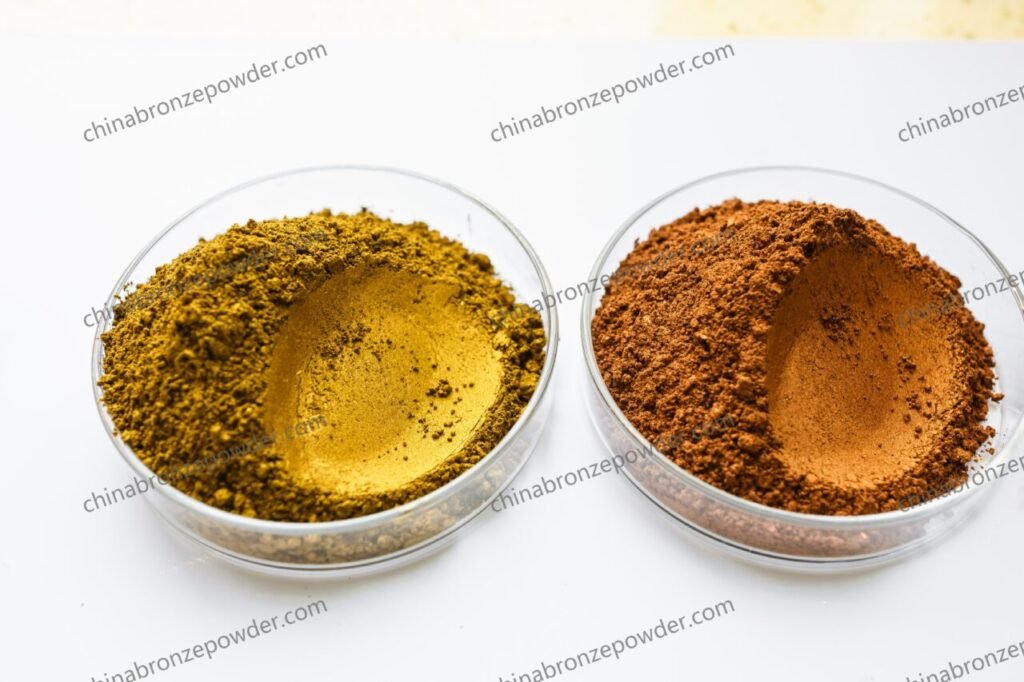
1. Color Determined by Copper-Zinc Ratio
Different composition ratios present different metallic hues:
| Type | Typical Composition (Cu/Zn) | Color Characteristics |
|---|---|---|
| Red Gold Powder | 90/10 | Reddish gold, high saturation |
| Bright Gold Powder | 85/15 | Bright gold, commonly used in printing industry |
| Green Gold Powder | 65/35 | Greenish, lighter gold |
This structure enables bronze powder to produce mirror-like reflections similar to gold leaf, making it the preferred metallic pigment for high-end decoration.
2. The Production Process of Bronze Powder: From Alloy to Shiny Powder
The brightness, stability, and weather resistance of bronze powder are highly dependent on the production process. Its manufacturing generally includes five key stages: “Melting — Crushing — Ball Milling — Grading — Surface Treatment.”
Step 1: Copper-Zinc Alloy Melting
The alloy is melted at high temperatures of approximately 800–1000°C to ensure uniform metal composition.
Step 2: Cooling and Crushing
After cooling, it forms metal flakes, which are then broken into flaky particles using crushing equipment.
Step 3: Ball Milling for Shaping
Ball milling determines the particle size fineness, flake structure, and gloss of the bronze powder, making it a crucial step for quality.
Step 4: Grading
Different particle size grades are obtained through sieving.
Step 5: Surface Treatment
Enhanced through resin coating or organic acid treatment to improve:
- Oxidation resistance
- Weather resistance
- Dispersibility
- Compatibility with ink/coating systems
3. Core Performance Advantages of Bronze Powder
As a metallic effect pigment, bronze powder offers the following outstanding advantages, which are the main reasons for its wide application in industrial fields.
First, Strong Metallic Luster
The flake structure of bronze powder provides strong reflectivity, presenting a metallic texture close to that of gold leaf.
Second, Rich Color Range
From yellowish-red to light gold, it can meet the aesthetic needs of different industries.
Third, Cost Far Lower Than Gold Leaf
The cost of bronze powder is about 1%–5% of genuine gold decoration, offering extremely high cost-effectiveness.
Fourth, Strong Adaptability
Applicable in:
- Oil-based systems
- Solvent-based inks
- Acrylic resin systems
- Plastic processing systems
Fifth, Mature Process and High Stability
High-quality bronze powder, after anti-oxidation treatment, can be used stably in most industrial environments.
4. Classification and Application Areas of Bronze Powder
Based on particle size and brightness, bronze powder can be divided into three categories:
1. Fine Bronze Powder
Characteristics:
- Fine particles
- Small color difference, good printability
- High hiding power, clear lines
Typical Applications: - High-end cigarette and alcohol packaging
- Cosmetic packaging
- Food packaging printing
- Trademark, LOGO printing
2. Medium Particle Size Bronze Powder
Characteristics:
- Moderate gloss
- Balanced visual effect
- Wide range of applications
Application Areas: - Metallic effect inks
- Decorative craft coatings
- Furniture coatings
- Ornament coating
3. Coarse Particle Size Bronze Powder
Characteristics:
- Strongest sparkle effect
- Intense surface reflection
Commonly used in: - Decorative coatings
- Advertising spray painting
- Toy coating
- Christmas products
5. Main Application Industries for Bronze Powder
Due to its metallic luster and stability, bronze powder plays an important role in multiple industries.
1. Packaging and Printing Industry
Bronze powder holds an absolute dominant position in gold inks for gravure, offset, and screen printing.
Applications include:
- Cigarette and liquor boxes
- Food packaging
- High-end gift boxes
- Greeting cards, invitations
Bronze powder can significantly enhance packaging quality and is a frequently used material for packaging designers.
2. Coatings Industry
Bronze powder is used in metallic effect coatings, such as:
- Craft gold paint
- Artistic wall coatings
- Furniture gold coatings
- Plastic paint
- Metallic paint
It can achieve various metallic textures like high gloss, bronze, and matte.
3. Plastics Industry
Adding bronze powder in processes like injection molding and extrusion can achieve:
- Metallic texture
- High reflectivity
- Bronze color effects
Commonly seen in: - Toys
- Christmas ornaments
- Household plastic parts
4. Cultural Creative Crafts and Architectural Decoration
Due to its bronze tones and stability, bronze powder is often used in:
- Buddha statue gilding
- Cultural relic restoration
- Architectural decorative gold paint
- Artistic ornaments
6. Typical Issues to Note When Using Bronze Powder
To ensure bronze powder achieves optimal results, special attention should be paid to the following points:
1. Keep Away from Acid/Alkaline Environments
Strong acids can corrode bronze powder, causing it to turn black.
2. Maintain Dry Storage
Avoid moisture affecting dispersibility and gloss.
3. Conduct Pre-testing with Resin Systems
Different solvents may impact the oxidation resistance of bronze powder.
7. Industry Trends for Bronze Powder: Evolution Towards Environmental Protection and High Performance
With the strengthening global trend towards “water-based” systems in coatings and inks, bronze powder is undergoing three major transformations:
Trend 1: Rapid Growth in Demand for Water-based Bronze Powder
Stability in water-based systems is significantly improved through resin coating technology.
Trend 2: Higher Brightness and Narrower Particle Size Distribution
Meeting the needs of high-end packaging and high-reflection processes.
Trend 3: Upgraded Weather Resistance and Anti-oxidation Technology
Expanding application scenarios from indoor to outdoor.
In the future, bronze powder will continue to develop towards environmental protection, high brightness, high stability, and broad scenario coverage.
8. Conclusion: Bronze Powder is Becoming a Mainstream Material for Industrial Golden Visuals
As a metallic effect pigment, with its stability, strong metallic luster, adaptability across multiple industries, and extremely high cost-effectiveness, bronze powder is becoming an indispensable material in industries such as packaging, coatings, plastics, and crafts.
Whether in high-end packaging design or industrial coating decoration, bronze powder is continuously driving innovation and upgrading in metallic visual effects.