Skip to content

In the era of increasingly stringent environmental regulations (such as VOC emission limits), the transition from solvent-based to water-based systems is no longer an elective—it is a mandatory requirement. However, for many manufacturers accustomed to solvent-based formulations, throwing bronze powder into water can feel like a “chemical nightmare.”
Today, let’s discuss: Can you actually use bronze powder in water-based systems? And how can we overcome the stability challenges that keep R&D engineers up at night?
1. The Core Conflict: When “Metal” Meets “Water”
Chemically speaking, bronze powder (a copper-zinc alloy) and water are naturally incompatible. In solvent-based systems, metal particles are surrounded by organic solvents, remaining relatively stable. In a water-based system, however, water molecules directly attack the metal surface, triggering a series of disastrous reactions.
A. The “Swelling” Crisis: Hydrogen Evolution
This is the most common accident in water-based metallic paints. Zinc is more reactive than copper and reacts with water to release hydrogen gas:

If this gas is trapped inside a sealed drum, it causes the lid to bulge at best, and leads to splashing or drum bursting at worst.
B. Fading Brilliance: Rapid Oxidation
Even without obvious gas production, dissolved oxygen and electrochemical corrosion in water can quickly form a grey-black oxide film on the surface of the bronze powder. You start with “Rich Gold” and end up with “Cement Gray.”
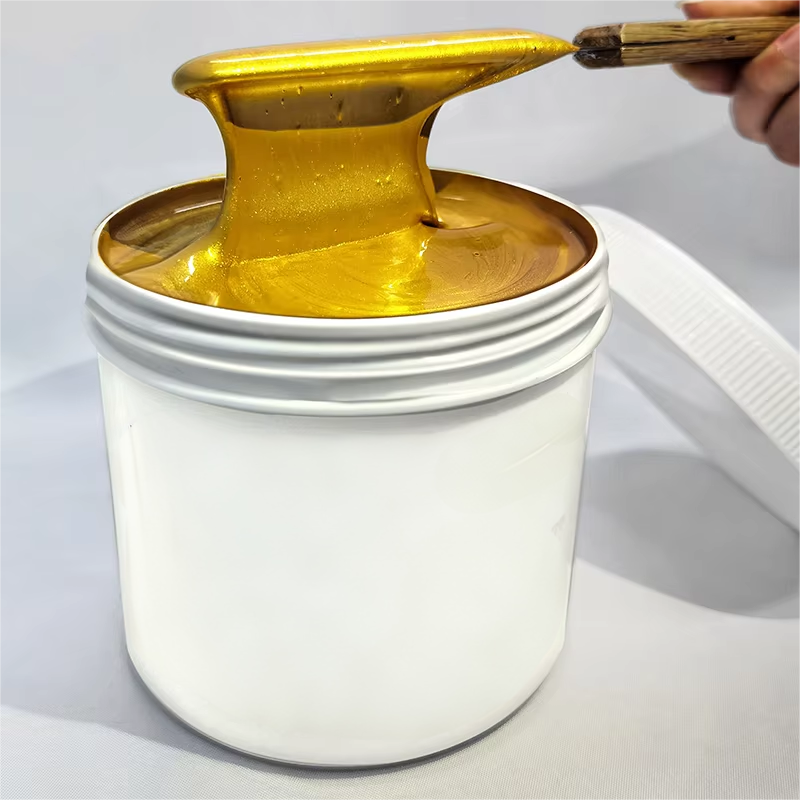
2. Three Major Technical Challenges in Water-Based Systems
Beyond the chemical reactions, using bronze powder in water-based systems requires overcoming three significant hurdles:
- Dispersion Challenges: Metal pigments have a high specific gravity and are naturally hydrophobic. In low-viscosity water-based systems, bronze powder is prone to sedimentation and clumping (“hard settling”), which is nearly impossible to re-disperse.
- The Flop Effect (Orientation): The beauty of metallic pigments comes from the parallel alignment of flake-like particles. The high surface tension and fast drying time of water-based resins often cause the flakes to “stand up” randomly, losing that metallic luster.
- Mechanical Shear Damage: To disperse metal powder, stirring is necessary. However, if the protective coating is not robust enough, high-speed shearing will strip the protective film off the powder surface, exposing the bare metal to the water.
3. The Breakthrough: Putting “Body Armor” on Bronze Powder
Since we cannot change the environment, we must change the powder itself. The industry-standard solution is surface encapsulation of the bronze powder.
A. Organic Encapsulation (Polymer Coating)
A very thin resin film is wrapped around the bronze powder through chemical grafting or adsorption.
- Pros: Good compatibility with water-based resins, easy to disperse.
- Cons: Limited weather and chemical resistance; mainly used for short-term decorative applications.
B. Inorganic Encapsulation (Silica-Coated)
This is currently recognized as the most reliable solution. Through a sol-gel process, a dense layer of Silicon Dioxide (SiO2) is grown on the surface of each bronze powder particle.
- Pros: Exceptional chemical stability. It acts like a “glass shield” to block water molecules, produces almost no hydrogen gas, and offers excellent acid and alkali resistance.
- Our Advantage: Our Water-based Series Bronze Powder utilizes multi-layer encapsulation technology, which not only solves the gassing issue but also maintains extremely high metallic brilliance.
4. Practical Advice for Engineers
If you are currently undergoing a water-based transition, here is a “de-bugging” guide:
- Choose the Right Powder: Never use standard oil-based bronze powder for water-based recipes. You must specify “Water-based Encapsulated Bronze Powder.”
- Monitor pH Levels: Bronze powder is sensitive to acidity and alkalinity. We recommend controlling the pH of your water-based system between 7.0 and 8.5. Excessive acidity or alkalinity will corrode the protective layer.
- Mind the Addition Sequence: We suggest pre-mixing the bronze powder with additives (wetting and dispersing agents) and a small amount of water or co-solvent to form a slurry before slowly adding it to the resin system. Avoid violent high-shear mixing.
Conclusion
Using bronze powder in water-based systems is indeed challenging, but with the right materials and processes, you can achieve a stunning metallic finish that is also environmentally friendly.
As a professional metallic pigment supplier, our Water-based Bronze Powder helping numerous clients transition smoothly to eco-friendly coatings.
Want to learn more about the experimental data for silica-coated bronze powder? Leave a comment below or contact us directly for technical support!